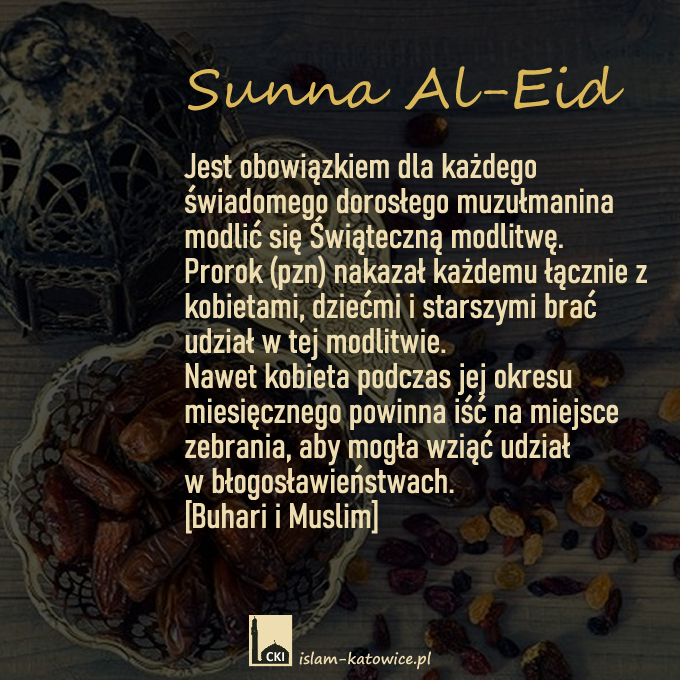
It is authentically reported that the Companion ʿAbdullah ibn ʿUmar (may Allah be pleased with him) would bathe on the morning of Eid. The Tabiʿi Saʿeed ibn al‑Musayyib said: “The Sunnah of Eid al‑Fitr consists of three things: walking to the prayer, eating before going out, and taking a bath.” [Saheeh – al‑Firyaabi & al‑Irwaa (2/104)] It is also known that Ibn ʿUmar used to wear his finest clothing on both Eid al‑Fitr and Eid al‑Adha, as mentioned by Ibn Hajar in Fath al‑Baari (2/439). The Eid prayer is obligatory upon every sane, adult Muslim.The Prophet ﷺ commanded everyone to attend the Eid prayer ― men, women, children, and the elderly. Even a woman who is menstruating should go out to the place of prayer in order to partake in the blessings of the day. [Al‑Bukhari and Muslim] It is from the Sunnah to eat dates before going out for the Eid al‑Fitr prayer, as a clear sign that fasting has ended, since fasting on Eid is forbidden. The Prophet ﷺ would not leave for the Eid al‑Fitr prayer until he had eaten a number of dates. [Reported by Anas ibn Malik; recorded by al‑Bukhari and Ahmad] It is Sunnah for men to recite the Takbir aloud while leaving their homes for the Eid prayer and to continue doing so until the prayer begins. [Silsilat al‑Ahadeeth as‑Saheehah, no. 171] It is preferable to perform the Eid prayer in an open area rather than in the mosque, if possible. [Al‑Bukhari and Muslim] There is no Adhan or Iqamah for the Eid prayer. [Reported by Ibn ʿAbbas and Jabir ibn ʿAbdullah; recorded by al‑Bukhari] It is Sunnah to say additional Takbirs during the Eid prayer: seven in the first rakʿah and five in the second. [Abu Dawood, Ahmad, and others] It is preferred to raise the hands with the first Takbir and then place them on the chest. However, it is authentically reported that Ibn ʿUmar used to raise his hands with every Takbir. It is Sunnah to take different routes when going to and returning from the Eid prayer, and walking is better if possible. Jabir (may Allah be pleased with him) reported that the Prophet ﷺ would return from the Eid prayer by a different route than the one he took to go. [Al‑Bukhari]What to Say on the Day of Eid The Prophet ﷺ used to recite the Takbir aloud while on his way to the Eid prayer. There is no authentic report specifying exact wording he consistently used, but Ibn Abi Shaybah reported that ʿAbdullah ibn Masʿood (may Allah be pleased with him) used to say:(Arabic transliteration) Allahu Akbar, Allahu Akbar, la ilaha illa Allah Allahu Akbar, Allahu Akbar, wa li‑llahi al‑hamd(Arabic translation) Allah is the Greatest, Allah is the Greatest, there is no god but Allah. Allah is the Greatest, Allah is the Greatest, and to Allah belongs all praise.
Related News
View All News
17 Jul 2026
3 Safar ، 1448
Jumu'a Sunnah Prayers
When any one of you observes the Jumu'a prayer (two obligatory rak'ahs in congregation), he should observe four (rak'ahs...
Read More
26 Jun 2026
11 Muharram ، 1448
O Boże, ześlij błogosławieństwo i pokój na Muhammada i rodzinę Muhammada
ٱللَّٰهُمَّ صَلِّ وَسَلِّمْ عَلَىٰ مُحَمَّدٍ وَعَلىٰ آلِ مُحَمَّدٍ O Boże, ześlij błogosławieństwo i pokój na Muhammada...
Read More
19 Mar 2026
30 Ramadan ، 1447
Takbīr – Eid al‑Fiṭr
Allāhu akbar, Allāhu akbar, Allāhu akbar, lā ilāha illā Allāh, Allāhu akbar, Allāhu akbar, wa li‑llāhi al‑ḥamd, Allāhu a...
Read More